The Next Generation of Sports Medicine Sutures
From Materials to Programmable Textile Engineering
Innovation in surgical sutures has traditionally been driven by advances in materials science. Over the past decades, the introduction of high-performance fibers such as polyester, ultra-high molecular weight polyethylene (UHMWPE), and advanced absorbable polymers significantly improved tensile strength, fatigue resistance, and biological compatibility.
However, while materials have evolved substantially, the fundamental architecture of most sutures has remained largely unchanged. The majority of sutures used in sports medicine procedures are still based on relatively simple constructions: round braided sutures, flat tapes, or monofilaments.
As arthroscopic and minimally invasive procedures continue to evolve, surgeons increasingly face situations where standard suture geometries may not fully match the biomechanical and anatomical requirements of modern repair techniques.
This raises an important question: What if the next major innovation in sutures does not come from new materials, but from new ways of engineering the textile structure itself?
Moving Beyond Traditional Suture Architectures
In traditional suture manufacturing, braiding machines produce uniform textile structures along the entire length of the filament. This means that the diameter, geometry, and mechanical behavior of the suture remain constant from end to end.
While this approach ensures manufacturing efficiency and consistency, it also limits the ability to design sutures optimized for specific surgical functions along different sections of the same construct.
Recent advances in textile engineering and automated braiding technologies are beginning to overcome this limitation. New manufacturing platforms now allow the programming of multiple textile geometries within a single continuous suture.
This concept, sometimes referred to as programmable textile architecture, allows different structural configurations to be integrated along the same suture strand.
For example, a single construct can incorporate:
• round braided sections optimized for knot strength
• flat tape sections designed for tissue compression and load distribution
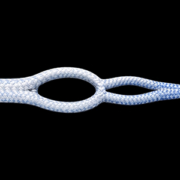
• looped segments for fixation constructs
• gradual diameter transitions for minimally invasive passage
Such programmable architectures open new possibilities for surgeons performing complex repairs in sports medicine.
Engineering Sutures for Function
The idea of tailoring textile geometry to surgical function is gaining increasing interest within the orthopedic community.
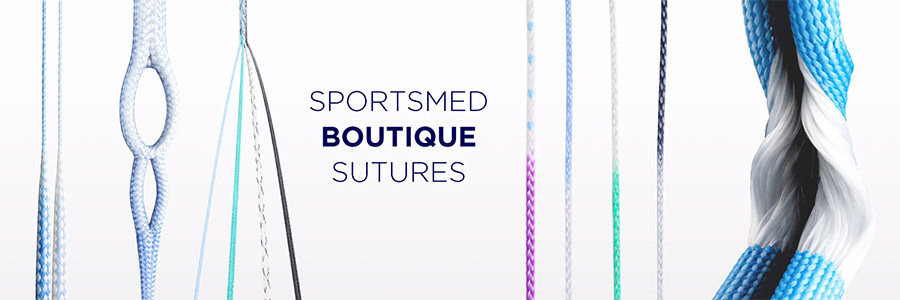
Several emerging concepts illustrate how textile architecture can influence performance:
Conical Sutures
One example involves conical sutures, in which the diameter gradually transitions along the length of the construct.
This geometry can allow:
• improved passage through small arthroscopic portals
• reduced tissue trauma
• preservation of mechanical strength in the load-bearing section
From a biomechanical standpoint, such structures may help balance the competing requirements of minimally invasive access and high mechanical strength.
Programmable Braiding
Another emerging approach involves programmable braiding systems capable of producing multiple textile configurations within a single construct. Instead of a uniform braid, the system can generate different structural zones along the filament.
These zones can be engineered to provide specific functional characteristics, such as:
• enhanced knot security
• improved tissue compression
• increased fatigue resistance
• optimized handling during arthroscopic procedures
Such architectures introduce a level of design flexibility previously unavailable in conventional suture manufacturing.
Multi-Limb Textile Constructs
Sports medicine procedures often require multi-strand fixation systems, particularly in ligament and tendon repairs.
New textile approaches allow a single braided structure to be divided into bifurcated or quadrifurcated limbs, enabling load distribution across multiple fixation points.
Potential benefits include:
• improved load sharing across repaired tissues
• more anatomical reconstruction patterns
• simplified surgical workflow
This architecture may support more sophisticated repair strategies without increasing procedural complexity.
Hybrid Textile Materials
Another area of innovation lies in combining multiple materials within a single braided construct.
Hybrid sutures may incorporate fibers with different properties, such as:
• high-strength UHMWPE for load bearing
• polyester fibers for structural stability
• absorbable polymers for temporary support
• biological materials such as collagen for tissue integration
By combining materials with different characteristics, hybrid constructs can be engineered to deliver balanced mechanical and biological performance.
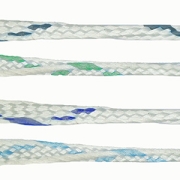
Color engineering can also play a role in surgical usability. Functional color patterns can serve as orientation markers, helping surgeons maintain spatial awareness during complex arthroscopic procedures.
Toward Textile-Based Ligament Scaffolds
Looking further ahead, textile engineering may also play a role in the development of ligament-inspired scaffolds.
Instead of functioning purely as sutures, advanced braided constructs may be designed to mimic certain structural characteristics of native ligaments.
Such scaffolds could potentially:
• provide mechanical stabilization during healing
• support tissue ingrowth
• preserve natural joint biomechanics
Although still an emerging field, these textile constructs represent an interesting intersection between orthopedic biomechanics and advanced textile manufacturing.
A Shift in the Innovation Paradigm
The evolution of sports medicine sutures may therefore reflect a broader shift in innovation strategy.
For many years, progress focused primarily on improving fiber chemistry. While material science will certainly continue to play a crucial role, the next wave of innovation may increasingly come from textile engineering and manufacturing technologies.
By enabling programmable architectures, hybrid materials, and multi-functional constructs, modern braiding platforms are expanding the design space available to engineers and surgeons alike.
Ultimately, the goal of these developments is not complexity for its own sake, but rather the creation of surgical tools that better align with the biomechanical realities of modern orthopedic procedures.
As sports medicine continues to evolve, the integration of advanced textile engineering into suture design may represent one of the most promising directions for the next generation of surgical repair technologies.